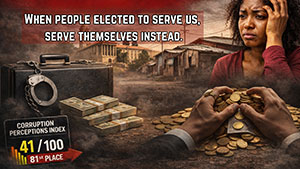
When people elected to serve us, serve themselves instead.
The fact that South Africa has a corruption problem is not news. Worrying? Yes. Damaging? Definitely. But news? Sadly not.
So why am I choosing to hang this article off the findings of the most recent (2025) Corruption Perceptions Index (CPI)?
Because for the past three years, nothing has changed – despite what many in government would like us to believe. The numbers don’t lie – our score has stagnated, much like our economy.
South Africa’s most recent score is just 41 out of 100, the same as in 2023 and 2024. This is below the global average of 42, and puts us in 81st position out of 182 countries.
This is in stark contrast to 1995, when we ranked 21st with a score of 57, alongside some of the least corrupt nations in the world, such as Belgium and Japan.
The only scant glimmer of hope is that the report highlights three areas where there have been significant improvements:
South Africa finally said goodbye to the FATF grey list, following consistent efforts from financial governance structures.
We hosted a successful G20 Summit.
Corruption allegations within the criminal justice system are being investigated by the Madlanga commission and the ad hoc committee of parliament.
So why, then, has our rating not improved?
Apparently, “The CPI measures perceptions of corruption, not actual reports from the public, which means that sometimes recent developments are not always reflected in the report.”
This is an excuse that Corruption Watch’s executive director, Lebogang Ramafoko, is simply not accepting.
“While our score has seldom given cause for celebration – remaining steadfastly below the 50 mark – the dip over the past two years to 41 is certainly cause for concern as it suggests that corruption is not being taken seriously enough by our leaders,” she said.
“It is time for governments and leaders to take decisive action in order to turn the tide against corruption. [We call] for renewed political leadership on anti-corruption, the protection of civic space, with an end to attacks on journalists, whistle-blowers and NGOs, and the closure of secrecy loopholes that allow corrupt money to move across borders.”
We’re all desperately looking for small wins to give us hope, and, as an optimist, I’d love to be able to find some. But it’s not easy.
“When corrupt officials and politicians continue to abuse their power, the frequent result is poor quality services and fiscal crises, as public funds are mismanaged, contributing to enduring poverty, rising inequality and worsening living standards for millions of people,” said Ramafoko.
Sadly, this will always be the result when the people we elect to serve us decide to serve themselves instead.
The state is no longer a guarantor of our rights, and the reality many face is this: to get what is rightfully yours, you have to play the system.
The sad thing is, that’s not even the worst of it. Because corruption steals far more than just money from pockets – it actively rewires the incentives of a nation so that the powerful are favoured and the honest are silenced.
Many of you will have watched President Ramaphosa’s rousing State of the Nation address a couple of weeks ago. Many cleverly written words were said, but I fear it’s going to take a lot more than words to make a positive difference that can be felt from CEOs to informal traders.
The Daily Maverick described the speech as, “a masterclass in political crowd pleasing,” that was ultimately “administratively and strategically ambitious.”
I would have to agree.
There were many vague and fleeting references to projects that sound impressive as a sound bite, but if you look under the first layer lack any real substance.
There was, for example, mention that Phase 2 of the Lesotho Highlands Water Project was “progressing.” Which, technically, it is. Yet, as I wrote in an article last month, it’s already five years past its original completion date and is not due to come online until at least 2028, possibly even later. The potential completion of this vital project 8 years late is not something we should be celebrating – especially given the dire water situation much of the country is in right now.
But, as always, our stock response to any uncomfortable truth is to look very busy rearranging the deckchairs on the Titanic – and shout loudly about doing how well we’re doing it.
There is no doubt South Africa is big on commitment. We’ve created numerous agencies with the investigative powers to uncover corruption. We were among the first countries to sign and ratify the African Union Convention on Preventing and Combating Corruption (AUCPCC), and in 2020 we adopted the national anti-corruption strategy.
Commitment? Tick.
Effective implementation? Not so much.
Despite persistent calls from numerous corners for a specialised, standalone anti-corruption body, South Africa’s approach remains siloed and scattered. We have a fragmented web of investigative agencies that are effectively toothless; they can uncover the rot, but can’t cut it out.
And if we continue to tether all criminal prosecution to the National Prosecuting Authority (NPA), all we’re doing is ensuring that the people doing the investigative digging are denied the legal muscle to take the action needed to end the graft.
It is endlessly frustrating, for example, that South Africa cannot take advantage of the commodities boom and increased platinum and gold prices – despite being a key producer of both metals – because corruption and dilapidated infrastructure continue to deter investors.
Scant wonder our economy hasn’t grown by more than 1% annually for the past ten years.
Once again, however, President Ramaphosa has big plans – he wants to modernise infrastructure and raise economic growth by as much as 3.5% by 2030.
There’s just one teeny weeny problem…we need about R1.6 trillion in public-sector infrastructure spending and R3.2 trillion from private investors to meet that target.
Which once again brings us back to the corruption albatross around our necks. Until we can shake off that pesky bird, investors are unlikely to throw those much-needed trillions at us.
I don’t want to be here at the same time next year writing another post-SONA article about how little has changed in the past year.
But if we don’t start stopping corruption instead of just talking about stopping it, I fear I very well may be.
Talk is cheap. The lives and futures of South Africans shouldn’t be.