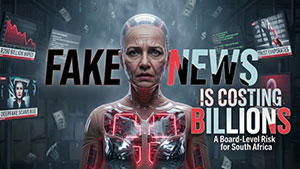
Fake News Is Costing Billions
It started with a two-minute video.
JSE Group CEO Leila Fourie stares into the camera, her voice measured and authoritative. “Invest now through this WhatsApp link,” she says. “300% returns guaranteed. Don’t miss out.” Her colleague, Director Mark Randall, appears in a follow-up clip: “Safe, secure, JSE-backed.”
Neither video is real. Not a single frame of it.
Both were AI deepfakes, cloned from public speeches in minutes using tools anyone can download for free. Desperate savers transferred money through Telegram. Telegram groups exploded with excitement. The JSE scrambled out an emergency alert: “100% fake.” But the damage was done. Trust evaporated. Copycat scams followed within days.
This is not a fringe problem. It is a corporate emergency.
The Numbers You Cannot Ignore
The 2025 Reuters Institute Digital News Report confirms what South African executives have been slow to accept: 58% of people globally say they cannot reliably distinguish real news from fake. Across Africa that figure climbs to 73%, the highest of any region surveyed. The Edelman Trust Barometer finds that 65% of South Africans specifically say it is increasingly difficult to tell genuine reporting from deliberate deception.
Either way, the majority of your customers, investors, and employees are navigating an information environment they do not trust.
SABRIC data shows a 1,200% surge in deepfake-related scams in South Africa over the past year. In 2024, digital banking fraud cost South African banks over R1.4 billion, a 74% increase year on year, as criminals deployed AI-generated phishing, voice cloning, and deepfake impersonations to exploit human error rather than system flaws. A JSE-listed firm nearly lost R100 million after a video of a Vodacom executive’s face was swapped onto a recording demanding urgent wire transfers. It was caught in time. Many are not.
Globally, a widely cited 2019 study by the University of Baltimore and cybersecurity firm CHEQ put the annual cost of fake news to the global economy at $78 billion. That figure is now six years old and widely considered an undercount. Stock dips from ESG hoaxes. Boycotts from viral smear campaigns. Supply chains paralysed by fabricated safety alerts.
The World Economic Forum’s Global Risks Report 2025 identified misinformation and disinformation as the single most pressing short-term risk to the global economy.
How a Rumour Killed R200 Billion
Look back to December 2017. Steinhoff’s shares were trading near a R200 billion market cap when a German newspaper published allegations of accounting irregularities. CEO Markus Jooste resigned within hours. Within days, the share price had cratered 85%, wiping nearly R190 billion in market value. At that point, no forensic proof had been published. No full audit had been completed. The market moved on incomplete information at extraordinary speed.
What followed confirmed the allegations in full. A PwC forensic investigation later found that Steinhoff had manufactured approximately €6.5 billion in fictitious profits across multiple years, one of the largest accounting frauds in corporate history.
The lesson here is not that rumours brought down an innocent company. It is that in the digital age, the gap between allegation and market verdict has collapsed to hours, long before any investigation can establish the facts. For executives with nothing to hide, that speed is just as dangerous as it is for those who do.
Tongaat Hulett followed a different but related pattern. The company’s accounting irregularities were real, eventually confirmed by forensic investigators. But the speed at which unverified allegations spread online accelerated the market damage dramatically, halting sugar exports and contributing to a market cap collapse of 70% before the full picture emerged. Insiders say that the absence of early counter-communication allowed the narrative to take hold long before the company could respond coherently.
A 2025 Business Report investigation linked xenophobic hoaxes directly to 10% JSE dips in retail stocks. African markets have been documented swinging 5-15% on unverified social media content, according to Trifacts data.
The Hidden Balance Sheet
The damage cuts across every part of a business. Here is what the data shows across confirmed South African cases:
FINANCE Deepfake bank scams
Direct impact: R1.4bn in fraud losses Ripple: Investor flight, higher premiums
OPERATIONS 2021 July unrest
Direct impact: R50bn economic wipeout Ripple: 2 million jobs lost or affected; supply chains broken
REGULATION POPIA: DoJ ransomware breach
Direct impact: R5m fine (first of many) Ripple: Compliance overhaul, legal costs
MARKETS JSE deepfake executive videos
Direct impact: Scam alerts halt trading Ripple: Volatility spikes of 20%
South Africa’s Unique Exposure
South Africa has 25 million social media users. Ninety-three percent are on WhatsApp. Seventy-seven percent are on TikTok. These platforms are not just communication tools. They are the primary news sources for millions of South Africans, and they are almost entirely unmoderated at the community level.
Government trust sits at just 36%, creating fertile ground for misinformation to outrun official statements. Foreign actors have taken note. A 2025 deepfake featuring a fabricated Anglo American internal memo about “collapsing mines” sent insurance premiums up 15% before the company could issue a denial. Insiders at a Pretoria fintech firm describe weekly attempts involving cloned CEO voices targeting their treasury teams. SABRIC’s hotlines are overwhelmed.
Media literacy levels compound the vulnerability. South Africa’s digital users are among the youngest and most active social media consumers in the world, but receive little formal training in identifying manipulated content. That gap is exactly what bad actors exploit.
One CMO at a JSE Top 40 firm described it plainly: “We lost a tender after a fake tender-rigging video went viral. By the time we debunked it, the decision had already been made.”
What the Frontlines Look Like
At a 2025 banking summit, SABRIC’s CEO issued a direct warning: “Deepfakes are the new phishing. They are personalised, targeted, and almost impossible to detect without the right tools.”
A Vodacom executive recounted a fake “network outage due to sabotage” post that crashed their customer service lines and dipped shares 3%. A Pick n Pay competitor lost 8% of sales after a viral, and debunked, “racist pricing” clip circulated on TikTok.
The pattern repeats internationally. In Hong Kong in 2024, a deepfake video of an HSBC executive “admitting fraud” erased $500 million in market value within hours. South Africa’s version of this scenario is not a question of if. It is a question of when.
Mining companies report Chinese-linked disinformation campaigns targeting their labour practices, timed to coincide with contract negotiations. Gen Z accounts spread 70% of fabricated content, often without knowing it is fake. Youth-driven platforms are now the front line.
The SA Election Warning Shot
In the 2024 national elections, deepfake videos of President Cyril Ramaphosa “confessing” to election fraud reached 2 million views before Africa Check debunked them. The IEC issued emergency requests to Meta and TikTok. Russia-linked accounts amplified the videos. Voter turnout dipped. The damage to public confidence in the electoral process outlasted the corrections by weeks.
Follow the digital trail on these campaigns and the culprits are rarely shadowy state operatives. They are opportunists using free AI tools available to anyone with a smartphone.
What Executives Must Do Now
King IV makes this a board-level fiduciary obligation, not a communications problem. Here is what the companies holding the line are actually doing:
Build a 24/7 rapid response unit.
Set up Africa Check alerts and NewsGuard browser extensions. The target: debunk within 60 minutes. Speed reduces virality. One FTSE JSE CEO cut response time by 80% using Brandwatch monitoring.
Deploy AI detection tools.
Brandwatch and Meltwater provide sentiment tracking. Hive Moderation flags deepfakes. The cost is around R500,000 per year. That is a fraction of the R1 billion exposure.
Run quarterly deepfake simulations.
Use SABRIC training modules for all staff. Scenario: a fake CEO resignation video drops at 9 AM. Who calls who? What is the approved script? Legal sign-off ready?
Audit your POPIA compliance now.
South Africa’s first POPIA administrative fine was R5 million, issued against the Department of Justice for failing to protect data after a ransomware attack. Fines cap at R10 million. Criminal liability for executives is also on the table. The legal and reputational costs of non-compliance dwarf the fine itself.
Build coalitions before you need them.
Join IEC coalitions and Media Monitoring Africa. Lobby the JSE for formal disinformation alert protocols. Companies that act first build credibility that holds during a crisis.
South African business, measured as a sector against government, media, and NGOs, carries a trust rating of 68%, the highest of any institution in the country, according to the Edelman Trust Barometer. That number took decades to build. A convincing deepfake can start dismantling it before your PR team sees the notification.
This is not a communications problem. It is not an IT problem. It is a board-level risk that belongs in the same conversation as liquidity, compliance, and cyber security. Companies that have not yet experienced a disinformation attack are not safe. They are just next.
The lie is already being written. The voice clone is being trained. The fake video is being rendered. The only question that matters right now is whether your organisation will be ready when it drops, or whether you will spend the weeks that follow trying to recover ground you should never have lost.
EDITOR’S NOTE ON STATISTICS: The 58% global figure is from the Reuters Institute Digital News Report 2025. The 73% figure is for Africa as a continent, the highest-concern region in the survey; it is not a South Africa-specific figure. The Edelman 65% figure is from the 2025 Edelman Trust Barometer and measures a related but distinct question specific to South Africa. The SABRIC 1,200% surge and R1.4 billion in digital banking fraud losses are from SABRIC’s 2024 Annual Crime Statistics report; the R1.4 billion covers all digital banking fraud, not exclusively deepfake incidents. The $78 billion disinformation cost figure originates from a 2019 University of Baltimore/CHEQ study; it is widely cited but dated and has not been updated with a 2025 equivalent. The 2021 unrest cost of R50 billion and 2 million jobs “lost or affected” are confirmed by the SAHRC report released January 2024. The first POPIA fine of R5 million was issued against the Department of Justice and Constitutional Development for a 2021 ransomware breach, not a private company. Steinhoff market cap of close to R200 billion is confirmed at the time immediately before the December 2017 collapse; the total investor loss across the scandal exceeded R250 billion.