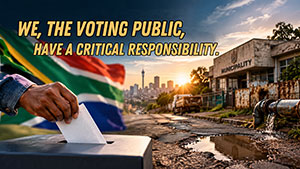
We, the Voting Public, Have a Critical Responsibility.
South Africa’s recent history, perhaps like that of many developing countries, can be traced with a “join-the-dots” puzzle of landmark “firsts.” From our first democratic elections back in 1994, to becoming the first African nation to lead and host the G20 summit in November last year, we are sculpted by a variety of political milestones that have created the complex, multi-party landscape we now have in 2026.
But although tomorrow’s municipal elections are not the first since becoming a democracy, they are undoubtedly some of the most significant of the past 30 years. Admittedly the outcome – even if it signals a radical change of political banners across our 257 municipalities – will not instantly repair our broken municipal infrastructure or erase billions in accumulated irregular expenditure. But if we put our precious X’s where our mouths are, if we collectively show we are tired of municipal mismanagement, infrastructure decay and service delivery failures, it could well trigger another first – our first step towards a more hopeful, brighter future.
And yet, although first steps, when taken in the right direction, are exciting, they usually don’t change anything in the immediate term – particularly for suppliers doing business with local government. For those businesses, the real story begins the very morning after the votes are counted.
Because a change in local government leadership is not a silver bullet, and it does not miraculously clean the administrative slate. If previous elections are anything to go by, it triggers instead a period of operational volatility: Administrative purges of city managers and chief financial officers, immediate freezes on outgoing contract awards, payment delays, and forensic reviews of agreements signed in the dying months of the outgoing term.
The empirical reality of our ailing municipalities is laid bare in the Auditor-General’s (AGSA) 2024/25 Municipal Finance Management Act (MFMA) general report.
In it, Auditor-General Tsakani Maluleke reports that over the four-year term of the outgoing administration, mayors and councils either made limited progress in strengthening governance or arresting financial decline, or actually regressed in their ability to do so.
“Regressions in audit outcomes should be a rare occurrence, particularly in the absence of significant changes to legislation or reporting requirements,” she said.
The numbers, sadly, show that this is not the case.
The AG’s report shows that despite the risks of their continuing underperformance, most failing municipalities showed little commitment to attaining clean audit outcomes. Over a third have remained in the unqualified audit opinion for between two and four consecutive years, a fifth have done so for five to nine years, and 17% for at least a decade.
“This complacency, in part, is due to accounting officers and political leaders misconstruing an unqualified audit opinion with findings as a good audit outcome, instead of a stepping stone towards a clean audit,” she said.
Other numbers revealed in the report further underline the severity of the situation:
Only 39 municipalities (15% of all local authorities) achieved a clean audit in 2024/25. Together they administer just R52.60 billion, a mere 8% of the total local government expenditure budget.
38 municipalities – including three that previously held clean audit status – performed worse than at the start of their term in 2020/21.
194 municipalities submitted material misstatements in their financial statements, 184 failed to prevent unauthorised, irregular, or fruitless expenditure, and 152 breached procurement and contract management regulations.
131 municipalities failed to implement statutory consequence management against officials implicated in financial misconduct
116 municipalities operated on unfunded budgets for four consecutive years.
Municipalities wrote off R62.12 billion in uncollected debt due to inadequate billing, poor debt collection, or weak management.
72 projects (over half of all awarded) experienced significant delays, running an average of 25 months behind schedule.
An additional 70 projects suffered cost management failures/losses, 30 were highlighted for poor-quality construction, and eight were completed but left unused.
The report reveals a glaring disregard for legislation and a lack of consequences for non-compliance, citing this as the “most pervasive failure in local government, with the non-compliance pattern observed in the previous administration continuing.”
It goes on to say that “Irregular expenditure caused by deviations from procurement and payment legislation and processes should remain a critical concern for all stakeholders in the accountability ecosystem. It serves as a tangible indicator of the failure to uphold the principles of good governance.”
After over 30 years of democratic governance, there is simply nowhere else to lay the blame for this blanket of decline except squarely at the feet of the municipalities themselves. The breakdown in service delivery has become an operational model.
So the big question is, will tomorrow’s elections bring any hope for honest contractors hoping to do legitimate business with our municipalities?
On the surface, it doesn’t look promising.
Maluleke says post‑election changes in political leadership often contribute to further regressions in municipal audit outcomes. It seems the success or failure of the 7th democratic local administration rests on the calibre and capability of the elected leaders.
And this is where, as the voting public, we have a critical responsibility. We must ensure that no matter which party we support, the leaders we choose must have both the integrity and the skills to carry out their duties ethically, responsibly and transparently.
This is particularly important in our metros, with experts predicting Johannesburg will be one of the fiercest battlegrounds in tomorrow’s elections. It’s unlikely that one party will win a 50% majority, so coalition negotiations should determine not only the city’s next mayor, but the administration taking on the mammoth task of trying to reverse years of political instability and deteriorating services.
All of which means the next 100 days will be key for our new municipal leaders and all those suppliers looking to serve them.
If that’s you, here’s a checklist to help safeguard you through this testing time:
🔲 Make sure you have written confirmation from the chief financial officer that your contract is backed by an approved, funded budget (Don’t fall into the trap of the working for a municipality operating on unfunded budgets).
🔲 Confirm that the procurement process followed competitive bidding and quotation procedures and make sure your appointment letter and SLA match the original tender specifications.
🔲 Make sure all project instructions, scope variations, and variations to contract conditions are issued in writing by authorised officials.
🔲 Establish internal conflict-of-interest checks to ensure none of the directors, shareholders, or associated subcontractors have undisclosed political or municipal employee ties that could trigger non-compliance or fraud investigations.
🔲 Implement rigorous, date-stamped site and delay logs of all project activities, weather impacts, and municipal-induced delays to protect against cost management disputes and contract penalties.
🔲 Establish independent quality-assurance audits on work executed by subcontractors to ensure compliance with technical standards.
🔲 If yours is a grant-funded project, verify that the allocating department and municipality have fulfilled transfer conditions to avoid work stoppages caused by weak grant management.
🔲 Ensure a clear, written handover process upon project completion to prevent assets sitting unused.
🔲 Confirm that your banking details and corporate profile on the Central Supplier Database (CSD) are locked to prevent unauthorised changes or payment fraud.
🔲 Establish clear internal governance protocols to suspend non-essential work if invoices are not paid within the statutory 30-day payment window.
🔲 If your project relies on municipal bulk water or power connections, monitor local outage rates and losses and factor backup power/water provisions into your operational plans.
🔲 Assess whether the municipality is subject to debt-relief conditions or credit restrictions that could impact its cash flow or ability to settle contractor accounts.
🔲 Review all project transactions, invoices, and variations against Auditor-General criteria to ensure you’re ready for audit before external reviews commence.
🔲 Check all subcontractor payments and third-party demands exceeding R100,000 for any signs of corruption, extortion, or tender fraud.
🔲 Audit all job cards, delivery notes, and retention funds to ensure bulletproof documentation for any past or pending payments.
Remember: Tomorrow’s ballot may change the people in the council chambers, but it will not rewrite the contracts in the filing cabinet.
For suppliers, the safest path through the next 100 days is neither blind optimism nor retreat, but disciplined vigilance: verify the mandate, document every instruction, protect every payment claim, and insist on accountability at every turn.
New councils may inherit old contracts – and old problems – but well-prepared contractors don’t have to inherit the risk.