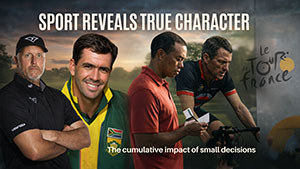
Sport Reveals True Character
At some point in your career, you made a decision you would not want splashed across the front page of every newspaper in the world.
So did Hansie Cronje.
The difference between you and him is not character.
It is that he was famous, and that someone was recording his phone calls.
The Man South Africa Trusted
In April 2000, the Delhi Police released transcripts of phone conversations between South Africa’s cricket captain, Hansie Cronje, and an Indian bookmaker named Sanjay Chawla. In those conversations, Cronje discussed fixing matches for money.
The country did not believe it. Could not believe it. This was Hansie, after all. The devout Christian. The captain who wore his faith on his sleeve and his values on his face. South African schoolchildren grew up wanting to be him.
When the King Commission of Inquiry convened, Cronje initially denied everything. Then, piece by piece, he admitted to receiving between $10,000 and $15,000 from bookmakers in exchange for information and influence over match outcomes. The United Cricket Board banned him from cricket for life.
What makes his story relevant to this article is not the cheating itself. What makes it relevant is the gap. The gap between who Hansie Cronje appeared to be and what he was actually doing, in private, when the consequences felt manageable.
He did not wake up one day and decide to corrupt international cricket. He made a series of small decisions, each one justified to himself in the moment, each one invisible to the public watching from the stands.
That gap is where integrity actually lives. Not in the values statement on the wall. In the decisions made when no one is watching.
Sport is one of the few arenas in life where character steps out from behind the title, the office, and the reputation. Under pressure, with consequences on the line, people make choices that reveal exactly who they are. The board presentation and the annual report can be polished. The golf score, and what happened before it, cannot.
This is not an article about sport. It is an article about the power of small decisions to destroy reputations and lives.
The Scorecard That Nearly Slipped Through
In April 2013, Tiger Woods played the 15th hole at Augusta and took an incorrect drop after his ball struck the flagstick and rolled into the water. He signed his scorecard. The rules committee reviewed footage and concluded he had not breached the rules. Then a television viewer called in. Broadcast evidence changed everything. Woods received a two-stroke penalty but avoided disqualification on a technicality, the committee had already made its ruling before he signed his card.
The rules of golf saved him. His own judgment did not.
What would have happened if there were no television cameras? If no viewer had picked up the phone? The answer is that Tiger Woods would have played on with a score he did not legitimately earn, and no one would have known. The institution protected a high-value individual. The technology was the only check on the system.
In your organisation, what checks exist for the high-value individuals? Who calls in the footage?
The Calculated Decision
Phil Mickelson has never been accused of subtlety. At the 2018 US Open at Shinnecock Hills, his ball was racing away from him down the 13th green toward a very difficult lie. He walked over and deliberately struck the moving ball to stop it. It was against the spirit of the game by any measure. It was not, technically, against the rules in a way that would disqualify him. He received a two-stroke penalty and kept playing.
When asked about it afterward, Mickelson said it was a “calculated decision.” He knew the penalty. He weighed the alternative. He chose the option that served him best in the moment, within what the rules allowed, and he said he would do it again.
Here is the question his example raises, and it is one worth sitting with.
If something is technically permissible, does that make it ethical?
In business, in procurement, in governance, this question comes up constantly. The contract structured just inside what the regulations allow, but not ethical. The disclosure that is technically complete but practically misleading. The tender process that follows procedure on paper while the outcome was decided months earlier.
Mickelson was not disqualified. He was also not forgiven. His reputation absorbed the cost of that calculated decision. It always does, eventually.
The Infrastructure of Deception
Lance Armstrong did not just cheat. He built a system to cheat systematically.
Seven Tour de France titles. Systematic doping across a decade. And then, when people started to ask questions, a campaign of legal intimidation and personal destruction aimed at anyone who told the truth.
When the US Anti-Doping Agency published its 2012 report, it described the most sophisticated, professionalised doping programme in the history of sport. Armstrong was stripped of all seven titles and banned for life.
Lance Armstrong’s lasting legacy is not just the cheating, it is the extremes he went to, to discredit anyone who cast doubt on his story. It is the maintenance of the lie. The energy spent, the resources deployed, the people implicated, the institutions compromised, all to protect a version of events that was never true.
Anyone in forensic investigation will tell you that the cover-up is almost always worse than the original act. It involves more people, more decisions, and more exposure. The thread that eventually unravels the whole thing is rarely the original mistake. It is the decision made six months later to keep it hidden.
Being Adjacent Is Not the Same as Being Innocent
In 1919, eight Chicago White Sox players deliberately lost the World Series in exchange for money from gamblers. Shoeless Joe Jackson’s precise role has been debated for over a century. What is not debated is that he knew something was wrong, said nothing, and played on. He was banned for life regardless.
Being in the room when a decision is made, knowing about a practice and staying quiet, signing off on a document without asking the question you know you should ask. None of those things constitute active fraud. All of them carry consequences.
In Canadian athletics, the 1988 disqualification of Ben Johnson for steroids at the Seoul Olympics looked, at first, like one athlete’s failure. The Dubin Inquiry that followed revealed that doping was widespread in the sport, that coaches knew, that officials knew, and that a culture had been allowed to exist because no single individual felt the weight of the whole thing on their own shoulders.
As in the case of Lance Armstrong, one person caught, an entire system exposed.
Now, the Question You Have Been Avoiding
It is easy to read about the mistakes of others. Hansie. Tiger. Lance. Phil. Their names are in the public record. Their failures were broadcast to millions. The scale of what they did, and the scrutiny they faced, is something most of us will never experience.
But consider the versions of these choices that exist in your world.
The expense claim nudged slightly beyond what it should be. The conflict of interest mentioned casually, but not formally declared. The performance review softened because the conversation would be uncomfortable. The subordinate who raised a concern, and was quietly managed out a year later.
The grand stage of professional sport simply amplifies a truth that exists in every office, boardroom and home: integrity isn’t a value statement on a wall; it is the sum of the decisions you make when you think no one is looking.
Whether it is a “calculated decision” to bend a rule or the quiet maintenance of a convenient lie, the gap between your public reputation and your private choices will eventually close.
You may never be summoned before the King Commission or have your phone calls recorded by the police, but the infrastructure of your character is built one small, invisible choice at a time. Ultimately, you are the only one who has to live with the full transcript of your life.
When the cameras are off and the crowds are gone, the only question that remains is whether you, your family, friends and community can respect the person who is looking back at you in the mirror.
About JGL Forensic Services: JGL specialises in financial crime investigations for corporate and government clients. Where there is a gap between what should have happened and what actually did, we find it.