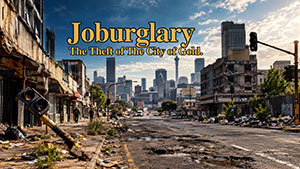
Joburglary. The Theft of The City of Gold.
Joburglary. Was there ever a more apt word to describe what is happening to our once Golden City?
It was officially codified in a report commissioned by the Global Initiative Against Transnational Organised Crime (GI-TOC) in partnership with the Centre for Development and Enterprise (CDE). They used it to define what they refer to as the “crime-council ecosystem” – the hybrid collusion between the city officials, businesspeople, and criminal syndicates who profit from service delivery failures.
And that, dear reader, is the crux of the issue.
Traditionally, Johannesburg’s steady infrastructural and administrative decay has always been framed as a tragedy of incompetence. We’ve blamed broken water networks, uncollected rubbish, disintegrating roads and other service delivery problems on inertia, corruption, budget deficits, and municipal paralysis.
But you can seldom accuse bad actors of letting a good crisis go to waste. Perhaps they’ve taken inspiration from the water and construction mafias, who strive to keep things broken so they can make money out of “fixing” them?
Whatever their motivation, the inescapable reality is this:
Institutional decay at the scale we see in Johannesburg doesn’t happen by accident; it happens because specific networks profit from it.
Where a city cannot produce audited financial statements, cannot account for irregular spending, and pays its contractors late, the people who gain are the ones who profit from weak controls, or who protect the positions they have built inside the system.
“Johannesburg is both broke and broken,” said Rise Mzansi’s Johannesburg mayoral candidate, Lukhona Mnguni, in an interview with The Debrief Network.
“Drive through parts of Johannesburg and you can watch the informal privatisation of municipal government taking place in real time.”
The problem with that is that the city will increasingly become a collection of functioning enclaves – where residents pay private operators for security, water, and power – surrounded by expanding municipal decline.
“But the problem with decay is it’s like cancer, it spreads,” says Lukhona.
Slowly but surely, it will bleed across municipal borders, eroding property valuations, commercial yields, and overall regional economic stability.
Mail & Guardian journalist Nhlanhla Mbatha believes a large part of the issue is that the people governing the city are all from one political party. He wrote in a recent article, “When everyone is from one party, accountability moves from the community to the party branch. The councillor’s survival depends on pleasing the branch, not the residents.
“Oversight collapses because no one wants to embarrass a comrade in council. And when a ward is a safe seat, there is no electoral incentive to deliver – the party knows it will win anyway.”
He cites Alexandra as a prime example.
“Poor service delivery is often caused by corruption, patronage, weak administration and the absence of consequences,” he says. “That is the dilemma facing voters on November 4. Vote opposition in your ward and you might get a principled voice but a powerless implementer. Vote for the governing party to align with the municipality, and you risk voting for complacency.”
The key take-away from the CDE report I mentioned earlier is that Johannesburg is being “managed” in such a way to keep it in a state of “profitable decay.” In other words, it needs to stay broken, but still able to function just enough so it doesn’t collapse completely. After all, why kill the goose that’s laying such profitable golden eggs?
If we’re honest, we have to admit that although the findings in the report are recent, the essential ingredients for the phenomenon it highlights have been there a long time – service delivery failures, accountability weaknesses and an overall lack of transparency. All it needed were a few clever cooks to design the recipe for Joburglary that is now providing tasty meals for hundreds of hungry individuals.
In an article for The Citizen, Ciaran Ryan writes that if we don’t fix Johannesburg, there is little hope for the rest of the country. He gives a startling snapshot of the problem:
- Joburg Water has an infrastructure backlog of R26.6 billion, and will take two centuries to replace all ageing pipes at current rates. In addition, none of its board members are professionally qualified engineers.
- The electricity infrastructure backlog is about R44 billion, and 54 132 power outages were reported between July and December 2025.
- 23 572 potholes were reported to the Johannesburg Roads Agency during the same period – that’s around 3 900 a month.
- In the final quarter of last year over half of the city’s traffic lights experienced faults.
- The Rea Vaya bus rapid transit system shut down critical feeder routes due to financial pressure.
- City murder rates have increased steadily since 2012, making Johannesburg among the most dangerous urban centres globally.
- Administrative chaos means it takes an average of 155 days and 20 steps just to get a building permit. This is 10 steps and 40% more costly than other member countries of the Organisation for Economic Co-operation and Development countries.
- Joburg owing creditors R25.2 billion but holding just R3.9 billion in cash.
The CDE believes Joburg’s utilities have become “primary sites for political patronage extended by the different parties in various governing coalitions. Board positions have been awarded to coalition partners and executives rotated with almost every political transition. The entities have stopped functioning primarily as service delivery organisations. They have become fiefdoms, each controlled by a different political faction and managed accordingly.”
Their executive director, Ann Bernstein, says that “It is vital that Johannesburg breaks the link between political change and administrative appointments. Senior appointments and board positions cannot continue to be treated as political bargaining chips.”
The municipal elections next month offer a critical turning point. Regardless of which parties form the new government, leadership must face the full scale of this breakdown and take decisive steps to stamp out institutional corruption and backroom collusion.
Ivor Chipkin, Associate lecturer, University of Pretoria, writes in an article for The Conversation, “Renewal in Johannesburg will confront interests that benefit from the current disorder. Some of these interests are inside formal politics. Some sit on boards, or in entities, departments and supply chains. Some operate through contractors, local brokers or criminal networks.
“A reform programme that threatens these arrangements should expect resistance. That resistance may take the form of litigation, obstruction, leaks, disinformation, labour disruption, sabotage of infrastructure, intimidation of officials, and violence around worksites and depots.
“Johannesburg’s recovery will require both professionalisation and enforcement. It will need a professional and relatively autonomous administration, but also a policing strategy capable of protecting infrastructure, officials, contractors and communities from organised disruption.”
Is this a realistic vision for Johannesburg? I for one hope so. But hope alone is not a strategy – and static policy documents won’t make a difference to a multi-billion-rand ecosystem engineered to profit from public ruin.
To reclaim Johannesburg from corrupt profiteers, we need to see a quantum shift from passive political hope to aggressive, forensic-led accountability. The incoming administration after November 4 must insulate municipal boards from political patronage, enforce strict procurement transparency, and deploy uncompromising law enforcement against infrastructure mafias. If it doesn’t, the city’s collapse will continue unchecked.
Decay is not inevitable, but the choice facing leadership, corporate stakeholders, and citizens is stark: either confront and break the syndicates extracting wealth from our municipal failures, or sit back and watch the the economic engine of our entire country be systematically stripped from within.