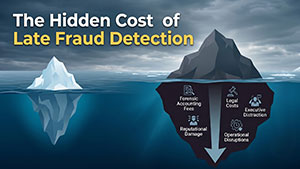
The Hidden Cost of Late Fraud Detection
Globally, organisations lose about 5% of their revenue to fraud every year – an eye-watering $5.5 trillion. But buried within that financial wreckage is one specific metric that should fundamentally change how business leaders approach risk management:
• Fraud detected within six months carries an average loss of $40,000.
• Fraud that remians undiscovered for five years or more costs around $1.115 million.
The longer you allow fraud to breathe, the more catastrophic the danger becomes.
Most companies falter early on, lulled into a false sense of security if they expose a rogue actor when they first exploit a control gap. The financial haemorrhage is often contained at that point, and many think they’ve won the battle.
But the war is only just beginning.
Fraudsters are nothing if not wily, stealthy, and infinitely patient. They’re happy to wait months before trying again, having learned well from their previous attempt. As time goes on, and months turn into years, they become increasingly confident, continually refining their methods of concealment, and slowly escalating the volume and/or velocity of their theft.
The potential cumulative financial damage after five or more years is truly catastrophic, and could bring all but the mightiest of corporate behemoths to their knees. Where many companies go wrong is they focus solely on the direct monetary or asset loss. This is a critical mistake; calculating the true cost of prolonged fraud must include the massive operational and reputational liabilities that lie beneath the surface.
Think of it as an iceberg of collateral damage.
The financial cost is merely the proverbial tip. Lurking beneath are the forensic accounting fees and legal costs, executive distraction and attrition, and often irreparable brand and reputational damage.
So how do you stop it? Where does your executive leadership look to stop the financial bleeding?
In its Occupational Fraud 2026: A Report To The Nations, the Association of Certified Fraud Examiners (ACFE) analysed 2 402 occupational fraud cases across 143 countries. The revelations are sobering to say the least.
Interestingly, ACFE data highlights a distinct split between where fraud happens most frequently versus where it inflicts the most severe damage.
Where the number of cases is highest, the risk is concentrated in ground-level business units. Accounting and operations lead the share of incidents at 13% each, with sales and customer service following at 10%.
The primary driver for fraud in these departments is proximity, as staff have broad, daily access to cash flows, inventory, purchasing systems, and financial records. Although the financial impact per incident is usually relatively low, when left unchecked, these schemes can cause huge damage over time.
In contrast, the most catastrophic losses occur at the top of the organisational pyramid. Although executive and upper management account for just 9% of total cases, they generate the largest average losses – around $345 000 per incident.
There is also significant financial destruction at board level, where average losses are about $316 000 per incident, and within finance departments, which average $200 000. Unsurprisingly, these losses are driven by senior leaders, who not only have the authority to bypass or override internal controls, but also have strategic-level access to the company’s core assets.
The figures in the report might all be US Dollar based, but South Africa’s recent economic history is a stark reminder that we have been anything but immune to the effects of this global dynamic.
The devastating era of State Capture, and systemic failures across once proud State-Owned Enterprises (SOEs) like Eskom, Transnet, and South African Airways (SAA), did not happen because we lacked anti-fraud frameworks.
They happened because corruption schemes, procurement abuses, and tender irregularities were allowed to persist for years without decisive intervention.
When governance structures are eroded from the top, internal control overrides become standard operating procedure. Rogue actors exploit complex supply chains and large-scale public procurement budgets over extended horizons. By the time judicial commissions, whistleblowers, and investigative journalists forced public interventions, the damage had moved far past direct financial theft.
The delayed detection and lack of accountability caused structural economic damage, rolling power crises, credit downgrades, and an immense loss of public trust. It’s an uncomfortable warning that when oversight is compromised at the most senior level, time is the ultimate enemy.
Surely then, one of the main aims of robust corporate governance must be to shrink the fraud detection window from years to weeks. But what does that actually look like?
Here’s what I believe we need:
• Stronger, modernised, whistleblower ecosystems: Courageous whistleblowers are still some of the primary exposers of fraud, with some figures showing they drive almost half of all detections. Their safety means strict adherence to the Protected Disclosures Act, and a shift from internal oversight on reporting channels to completely independent, multi-channel digital platforms. Employees must feel safe enough to speak up – and speak up early.
• Continuous behavioural and data analytics: Accounting and operations are high-frequency risk zones, meaning companies should deploy automated tools that flag anomalies – such as duplicate invoices and sudden changes to vendor master data – in real-time. We should be actively cross-referencing company registries, the National Treasury’s restricted suppliers database, and employee payroll files to expose hidden conflicts of interest and shell-company networks before contracts are signed.
• Mandatory separation of duties and oversight on senior management: Executive overrides account for some of the most severe losses. Boards must enforce strict independent oversight and real-time automated alerts for system overrides, so no single executive has unmonitored control over financial systems, or the power to bypass verification protocols. This will help to flag anomalous transactions in days rather than hiding in plain sight for years.
The bottom line is this:
There can no longer be any debate over whether or not your organisation is vulnerable to fraud. That kind of thinking is not only outdated but blatantly dangerous. We work in an environment of complex corporate networks and sophisticated financial instruments, so we must assume that fraud is either happening right now or being actively attempted.
An elite governance framework needs an aggressive commitment to more than just an unblemished record. It needs detection speed. By shifting focus towards shortening the fraud lifecycle, business leaders can protect their corporate reputation, preserve employee morale, and ensure that a comparatively minor operational failure is never allowed to escalate into a multi-million Rand threat.
This is one stark example of where time really is money. And lots of it.