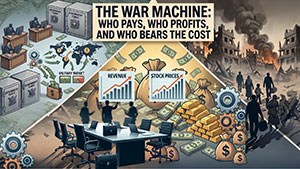
The War Machine: Who Pays, Who Profits, and Who Bears the Cost
Every war in modern history carries two parallel stories. One plays out on the battlefield, in bombed cities, in refugee columns, in casualty figures. The other plays out in boardrooms, government budgets, and commodity markets. Understanding both stories does not require taking a side. It requires following the money and counting the human cost.
Two Wars, One Pattern
In February 2022, Russia launched a full-scale invasion of Ukraine. By early 2026, CSIS estimated that Russian forces had suffered approximately 1.2 million casualties, including killed, wounded, and missing, between February 2022 and December 2025. Ukrainian forces likely suffered between 500,000 and 600,000 casualties over the same period. CSIS projected that combined casualties could reach 2 million by spring 2026, though casualty figures in active conflicts are difficult to verify and differ significantly across sources. Center for Strategic and International Studies
The economic toll on both countries has been severe. Ukraine’s economy at the end of 2025 was approximately 20% smaller than in 2021. The public sector deficit reached 25% of GDP in 2025, excluding foreign support, compared to single digits before the invasion. The combined spending on domestic security and defence, including military equipment supplied from abroad, accounted for more than a third of Ukraine’s GDP. On the Russian side, Russia directed roughly half its national budget to the armed forces and military-industrial complex, while its manufacturing sector suffered seven consecutive months of contraction in 2025 and economic growth slowed to 0.6%. Bank of FinlandCenter for Strategic and International Studies
Then, on 28 February 2026, a second major conflict ignited. Israel and the United States began a series of strikes against Iran, stating their objective was to induce regime change and target Iran’s nuclear and ballistic missile programme. The conflict left thousands of people dead in Iran and Lebanon, dozens dead in Israel and Gulf Arab states, and millions displaced across the region. House of Commons LibraryEncyclopedia Britannica
In Lebanon, the Lebanese government reported that over 1.2 million Lebanese nationals were displaced, corresponding to more than one-sixth of the country’s population, with over 40,000 homes in southern Lebanon destroyed. In Iran, the UNHCR estimated that as many as 3.2 million people were internally displaced since the conflict began. WikipediaTime
Iran’s response to the strikes had immediate global consequences. Iran closed the Strait of Hormuz, through which around 20% of global petroleum and 20% of liquefied natural gas normally flows each year. Pre-conflict, around 3,000 vessels used the strait monthly. Traffic dropped to approximately 5% of that level, pushing up global oil and gas prices. House of Commons Library
The Quincy Institute for Responsible Statecraft estimated that Washington’s costs over the first month of the Iran conflict were between $20 billion and $25 billion. By late April 2026, negotiations appeared deadlocked, with disputes over the Strait of Hormuz continuing to disrupt global energy supplies. Al JazeeraAl Jazeera
What Actually Drives Wars
Wars rarely have a single cause. They accumulate pressure over years, combining strategic interests, resource competition, historical grievances, internal political pressures, and ideology. What they share is that at some point, the key decision-makers concluded that the cost of fighting was lower than the cost of continued restraint.
In Ukraine, Russia cited NATO expansion and the security of Russian-speaking populations in eastern Ukraine as justifications for the invasion. Ukraine and Western governments characterised the invasion as a violation of international law and national sovereignty. Both positions contain internally consistent arguments, which partly explains why the conflict has been so difficult to resolve diplomatically.
In the Iran conflict, the Trump administration gave varied explanations for launching strikes: to forestall Iranian retaliation after an expected Israeli attack, to stop an imminent Iranian threat, to destroy Iran’s missile capabilities, to prevent Iran from developing a nuclear weapon, to seize Iran’s oil resources, and to achieve regime change. Wikipedia
Just before the strikes began, the Omani foreign minister stated that a breakthrough had been reached and that Iran had agreed both to never stockpile enriched uranium and to allow full IAEA verification. Talks were expected to resume on 2 March. On 28 February, following results deemed unsatisfactory in a third round of negotiations, US and Israeli strikes began. Wikipedia
That sequence, where a diplomatic opening closes just as a military operation launches, is not unique to this conflict. It reflects a structural pattern that appears across modern military history: wars are not always the failure of diplomacy. Sometimes they follow from a deliberate preference over it.
Who Benefits
The clearest financial beneficiaries of armed conflict are the companies that supply it.
RTX, parent company of missile-maker Raytheon, saw its revenues climb from $64.3 billion in 2021 to over $80 billion by 2024. Lockheed Martin’s turnover rose from $67 billion to nearly $71 billion over the same period. General Dynamics posted a record $47.7 billion in revenue, up nearly 25% from 2021. Democracy Challenged
The 2026 Iran conflict accelerated these trends further. Northrop Grumman reported a 4.4% increase in first-quarter 2026 revenue to $9.88 billion, attributing the growth to surging demand for its B-21 long-range stealth bomber. Lockheed Martin’s stock rose 3.4% on the Monday following the start of strikes on Iran. Al Jazeera
These companies do not simply respond to demand; they are active participants in shaping the political environment in which demand is generated. In 2023, the top five US defence contractors spent over $60 million combined on lobbying Congress, according to OpenSecrets data. Between 2020 and 2025, the top military contractors spent $110 billion on share buybacks and dividends, more than double what they spent on capital expenditure over the same period. Democracy ChallengedJacobin
Energy-exporting nations also benefited from the disruption. The closure of the Strait of Hormuz pushed up global oil and gas prices, benefiting Russia among others. Russia, operating under heavy Western sanctions and deep into an attritional war in Ukraine, saw its energy revenues partially buffered by a price spike triggered by a conflict more than 2,000 kilometres away. House of Commons Library
Governments can also extract domestic political advantages from conflict, independent of any security outcome. War can consolidate national identity, shift public attention from internal economic failures, and create conditions for emergency spending that bypasses normal legislative scrutiny. This dynamic has appeared across different political systems throughout modern history. It is not specific to any ideology or region.
Who Suffers
The answer to this question is consistent across every modern conflict, regardless of which party initiated hostilities.
Civilians bear the most concentrated cost. As of February 2026, 5.9 million Ukrainians had been recorded as refugees globally, and a further 3.7 million remained internally displaced within Ukraine. In Lebanon and Iran, millions more were forced from their homes within weeks of the February 2026 strikes beginning. Dubai International Airport, one of the world’s busiest, was damaged by drone strikes and temporarily closed. UNHCREncyclopedia Britannica
Military personnel on all sides pay with their lives, their physical health, and often their long-term psychological wellbeing. Most entered service out of duty, patriotism, or economic necessity. The decisions that placed them in harm’s way were made by people who are rarely in harm’s way themselves.
National economies absorb costs that take generations to recover from. Ukraine’s public sector deficit of 25% of GDP in 2025, excluding foreign support, represents a fiscal burden with no near-term resolution. Iran faces simultaneous damage from prolonged economic sanctions and the direct material costs of military engagement. Even countries supplying weapons face hidden costs: their arsenals are depleted and must be restocked at public expense. Bank of Finland
The global economy absorbs the ripple effects. Fuel prices rise. Shipping routes are disrupted. Agricultural supply chains that depend on output from conflict zones falter. The people least able to absorb those price increases, typically in lower-income countries far from the active fighting, bear costs they had no role in creating.
The Pattern Underneath
What the Russia-Ukraine war and the US-Israel-Iran conflict share is this: the people who decide to go to war are rarely the people who fight it, flee it, or pay for it across the decades that follow.
The financial architecture of the modern defence industry is structured in a way that sustains and, in concrete economic terms, benefits from prolonged instability. That is not a matter of speculation. It is observable in quarterly earnings reports, lobbying disclosures, and stock market data. The economic structure of the defence sector differs from most other industries because demand is not shaped by consumer choice or market saturation, but by government policy and threat perception. That structural reality exists independently of the stated intentions of any government or military commander. Democracy Challenged
None of this means every military action is driven purely by financial interest, or that security concerns are fabricated. Genuine threats exist. States have real interests to defend, and the decision to use military force sometimes reflects sincere security calculations. But the distance between the publicly stated reasons for war and the financial and strategic interests that benefit from it is wide enough to examine carefully, without requiring allegiance to any particular government or flag.
The war machine does not belong to one country, one ideology, or one era. It is a structural condition, sustained because enough institutions and decision-makers in enough countries have found it more useful than the alternative. Understanding that structure is not a political act. It is a factual one.
The civilians in Tehran, Kyiv, Beirut, and the towns along Ukraine’s eastern front did not build that structure. They are living inside it.
Sources: UK House of Commons Library; Britannica; CSIS; Bank of Finland; Quincy Institute for Responsible Statecraft; UN Refugee Agency (UNHCR); UN News; Norway Refugee Council; Human Rights Watch; Wikipedia (2026 Iran war, 2026 Lebanon war, Casualties of the Russo-Ukrainian War); OpenSecrets; published earnings data from Lockheed Martin, RTX, Northrop Grumman, and General Dynamics.