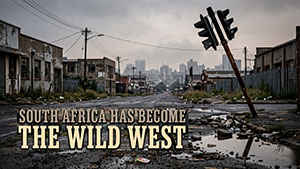
South Africa Has Become The Wild West
5.15am, her alarm goes off. She gets up early because they have not had power for two weeks so she needs to make a fire to boil water for breakfast and coffee for the family. She drives to work through the Johannesburg suburbs on roads so pot-holed, you would think you were in deepest, darkest Africa. She passes a train station that no longer has running trains. She stops at a traffic light that has not worked in months. When she finally arrives at the office, she has already paid the corruption tax four times.
By now you should be asking yourself, ‘Where did the money go?’
The money that was supposed to build power stations that work, roads that do not eat tyres, trains that actually run, taps that deliver clean water. Hundreds of billions of rand, collected from your taxes, your VAT, your fuel levies, your rates. Money that was supposed to build a country. GONE!
This is not a political debate. It is about something far more basic: the gap between the life you are living right now, and the life you would be living if the money meant for infrastructure and services had not been stolen by people who were supposed to serve you.
The Numbers Are Real
Let’s start with what we know.
The government’s own analysis found that corruption costs South Africa’s economy at least R27 billion every year, wiping out 76,000 jobs that would otherwise have been created. That is a conservative figure. When Pravin Gordhan testified before the Zondo Commission into State Capture, he estimated the total economic impact of state capture at R500 billion. From a single era of looting.
Eskom, the entity that is supposed to keep your lights on, is losing R1 billion per month to theft and corruption, according to the former CEO. Not a year. A month.
Since 2020, the South African government has spent R283 billion bailing out state-owned enterprises including Eskom, Transnet, South African Airways, and Denel. That money came from us, the taxpayers.
R1 billion per month. Stolen from the entity that is supposed to keep your lights on. While you sat in the dark.
Then there is the water crisis. The Auditor-General found that 59 municipalities spent R2.32 billion on emergency water tankers in the 2023 to 2024 financial year alone. Think about that. Instead of fixing infrastructure, municipalities are paying R2.32 billion to put water in trucks and drive it to communities that should have had clean running water years ago.
In the same period, South Africa’s water service authorities reported R14.89 billion in water losses through leaks and crumbling pipes. Today, 8.5 million South Africans have no access to basic water services at all. 87% of wastewater treatment plants tested do not meet minimum standards for discharge into the environment, according to independent Green Drop assessments. The government’s own Green Drop report found that only 8% of systems perform at excellent or good levels.
Our roads are another reflection of the widespread corruption. The South African Institution of Civil Engineering has repeatedly warned that the country’s road infrastructure backlog runs into the hundreds of billions of rand. You feel it every single day. In the potholes that destroy your suspension and tyres. In the accident that happened because the road markings have long since faded. In the extra hour your commute takes because the infrastructure was never maintained.
The collapse of the rail system
If you want to understand what corruption actually does to real people, look at South Africa’s commuter rail system.
In 2010, South Africans took over 500 million train journeys a year. By 2022, that number had collapsed to 19 million. Let that sink in. A National Household Travel Survey found that 80 percent of South African train users, roughly 550,000 people, have abandoned rail since 2013. Almost all of them are working-class South Africans who could least afford to find an alternative.
A Treasury investigation into 216 contracts awarded by the Passenger Rail Agency of South Africa between 2012 and 2015 found that only 13 were legitimate. Thirteen. Out of 216. The total value of those contracts was around R15 billion. A front company called Swifambo was paid R2.65 billion to supply 88 locomotives. It delivered 13. The locomotives it did deliver were too tall to run on South African railway tracks. The court later declared the contract corrupt. The company went into voluntary liquidation. And the commuters of Khayelitsha, Mitchell’s Plain, Soweto, and dozens of other communities were left to find another way to get to work.
Cape Town’s Central Line, the busiest line serving the city’s poorest communities, stopped running entirely in October 2019. One million additional commuters were pushed onto the roads every day. You used to be able to take a train to work for a fraction of what a minibus taxi costs, and get to your destination in a fraction of the time. That is money taken from the pockets of people who can least afford it.
The people who looted the trains did not lose their cars. The people who lost were the ones who needed the trains.
Commissions Without Consequences
South Africa has not been short of investigations. It has been short of consequences.
The Zondo Commission into State Capture ran for more than four years. It cost taxpayers close to R1 billion. It heard from 278 witnesses. It implicated more than 1,438 people by evidence. Its reports ran to thousands of pages. It made clear, named recommendations about who should face criminal charges.
How many of those 1,438 people are in prison? Very, very few.
The pattern is consistent and deeply predictable. A commission is announced. Millions are spent. Reports are published. Headlines are written. And then, slowly, the momentum fades. Cases drag on for years in the courts. The National Prosecuting Authority, under-resourced and under pressure, moves at a pace that tests the patience of every honest South African. Yet, the accused remain free. Some remain in public life. Some continue to access resources and platforms while the cases grind on.
Accountability Has A Price Tag
There is a painful truth that sits at the centre of South Africa’s accountability crisis. The consequences people face for breaking the rules depend heavily on how much money they have and who they know.
If you steal from your employer, the consequences arrive quickly. If you default on your rates account, the municipality will cut your power. If you are a small business owner and you fail to submit your tax returns, SARS will act. The system works fast when it is dealing with people who cannot afford to slow it down.
For others, the system moves very slowly, if at all.
Consider one of South Africa’s most prominent political figures, a leader who built an entire public profile around supposedly standing up for the poor and fighting the powerful. Charges were laid against this individual in 2018. Their first court appearance came in 2021. The conviction came in October 2025, more than seven years after the incident that gave rise to the charges. Sentencing happened in April 2026. A five-year prison term was handed down. Within minutes, an appeal was filed. The individual walked free. They remain in Parliament. They remain in public life. The legal process will continue and will probably drag on for years.
This is not an argument about guilt or innocence. Courts decide that. This is about what the slow, grinding pace of accountability communicates to every South African watching. It says that if you have enough money and enough lawyers, the system will accommodate your timeline. Most South Africans do not have that luxury.
The system works fast when dealing with people who cannot afford to slow it down. For others, it moves slowly, if at all.
The Gap
The gap between what South Africa could have been and what it currently is represents millions of individual lives that are harder, shorter, poorer, and more exhausting than they needed to be. That gap has a name. It is called corruption. And it is not an accident. Someone chose personal benefit rather than the greater good of society.
What Can You Do?
The people who benefit from corruption need you to stay angry but passive. They need you to feel that the problem is too big, too entrenched, too political to fight. They are counting on your disengagement.
So, stay engaged. Know your municipal budget. Attend public participation meetings. When your municipality announces a tender, ask who won it and why. Demand that your ward councillor accounts for every Rand of the infrastructure grant that comes into your area. When the Auditor-General releases findings, read them. When the SIU publishes recoveries, track them.
There are tools available to you. The SIU operates a corruption hotline. The Public Protector’s office exists to investigate abuse of power. Investigative journalists and civil society organisations are doing critical work to hold people accountable. They need public support and visibility. Share their work. Protect the people who blow the whistle.
Our ailing economy and infrastructure are the direct consequence of choices made by people who decided that their comfort was worth more than your life. How much longer will you sit on the sidelines and do nothing, expecting others to take action? It is time to step up and be accountable for your life and the future of your country.
Sources: Zondo Commission Final Report (2022); Auditor-General of South Africa Annual Reports (2023-24); PRASA SIU Investigation Findings; National Treasury Local Government Financial Data; Department of Water and Sanitation Green Drop/Blue Drop Assessments; Testimony of Pravin Gordhan, Zondo Commission; Former Eskom CEO Andre de Ruyter, Parliamentary Testimony (2023); Government analysis led by Economic Development Minister Ebrahim Patel (2017); Daily Maverick investigative reporting; GroundUp; Open Secrets.