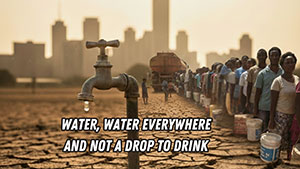
Water, Water everywhere and not a drop to drink
Pemmy Majodina, our Minister of Water and Sanitation, recently announced she is “washing her hands” of South Africa’s water crisis.
(Luckily for her, she still has the water with which to do this – unlike millions of her fellow citizens).
My question today is, how can someone with the title “Minister of Water” not be actively involved in trying to find a solution to the water crisis threatening to bring the city of Johannesburg (and others) to a grinding halt?
As I write, residents in numerous parts of Joburg have been without water for over two weeks; many for far longer. Schools, businesses and clinics have had to close. It’s an unmitigated disaster caused by a catastrophic, multi-system failure.
The Daily Maverick reports that in the last few days, the City of Johannesburg has established a task force to coordinate its response to the crisis.
(And we all know how much South Africa loves a task force).
The dramatically named Intergovernmental Water War Room will be used to “coordinate and fast-track interventions.”
According to an email it sent to the press, the task force will “bring together city authorities, Rand Water, the Gauteng provincial government and national representatives.
“This structure is actively monitoring the system in real time, coordinating technical responses, accelerating repairs, and implementing demand-management measures to stabilize (sic) supply and protect critical infrastructure,” it said.
I have to wonder about the phrase “implement demand-management measures.” To me, it has ominous shades of Eskom-esque load-shedding about it, but perhaps I should be more charitable?
Either way, the task force seems to lift Minister Majodina nicely off the hook.
Not that she felt she was on it anyway, clearly. Her most emphatic response to date has been a dismissive “it’s not my fault.”
In a statement made to Newsday, she said her department is constitutionally obliged to ensure water resources and bulk water supply. According to her, that job is done.
Making sure the water actually reaches the taps of the people she serves is apparently not in her mandate. That particular responsibility falls to local government.
Well, good luck with that.
In a recent, livestreamed address on Gauteng’s water crisis, Solly Msimanga, the DA’s Gauteng leader, said, “I just had an unbelievable call from the office of the premier, where his spokesperson told me that [they] are completely unaware of any kind of water crisis in the city of Johannesburg. All that they know about is that there are constraints in Soweto because of a broken reservoir. That is a direct quote.
“So anyone who was hoping that the provincial government would be taking its constitutional obligations seriously is on a fool’s errand.”
The Ministry of Water & Sanitation seems unmoved.
“Ordinary citizens are saying why don’t you amend the constitution so that when municipalities are dismally failing, then the department must take over,” said Majodina. “But currently, because we still have this constitution, we’re unable to take over. We have spheres of government, not layers. If it were layers, I was going to have intervened a long time by now.”
What do others think of this flimsy constitutional alibi?
“The minister’s role is unavoidable,” said the DA’s Stephen Moore. “[She] is the executive authority. She is empowered to instruct water boards like Rand Water to communicate properly, and she can demand aligned honest communication from municipalities.”
The Water Crisis Committee agrees, believing the government is constitutionally obliged to step in.
“Intermittent tanker provision, characterised by long queues, inconsistent schedules, unequal access and the absence of proper oversight, does not meet the standard of ‘sufficient’ access contemplated by the Constitution,” they said. “Nor does it satisfy the obligation of reasonable and sustainable service delivery under the Water Services Act.”
The Minister is right about one thing, though: South Africa does have enough water. The Vaal Dam is close to 100% full. The reason it isn’t reaching Johannesburg’s taps is gross mismanagement, crumbling infrastructure, and a lack of competent staff at local level.
Not that it offers any consolation to the thousands of Johannesburg residents with dry taps.
If the “further downs” aren’t doing their jobs properly, then surely it’s beholden on the “higher ups” to step in and rescue what is simply an unsustainable situation.
Depending on who you ask, Joburg Water loses between 35% and 50% of its water before it ever reaches a consumer. It leaks out of rusted, 60-year-old valves, bursts through high-pressure lines that haven’t been serviced since the 1980s, and is stolen through illegal connections.
In any other business, a 50% loss of your primary product is a terminal failure. In Johannesburg, it’s just Tuesday.
If you’re wealthy, you can buy your way out of trouble with a JoJo tank and a booster pump. You sink a borehole, install solar, and pretend the municipality doesn’t exist.
But what about the rest of the city; the millions who can’t spend R50,000 on a backup system? They are left to queue for water tankers that may or may not show up. They’re the ones who have to choose between hydration and hygiene.
When you take away people’s water, you take away their dignity. You remove the ability to run a business, keep a school open, or maintain a clinic.
You are effectively telling the population that their most basic survival is no longer a priority for the state.
And I have to ask if it is ever likely to be.
Gauteng relies heavily on the Lesotho Highlands Water Project. Phase 2 of that project was supposed to start in 2008. It is currently only 50% complete and won’t be online until 2028 at the earliest.
Even then, Dr. Phillips warns that it won’t be a magic bullet. He believes we need another massive project – possibly pumping water 600 kilometres from the Thukela catchment in KwaZulu-Natal.
Based on the current track record of infrastructure delivery, I have zero confidence that such a project will see the light of day in our lifetime.
I wish I had an answer, but my inspiration has run as dry as the taps in Midrand.
Does anyone out there have a suggestion that doesn’t involve waiting for a 2028 miracle?