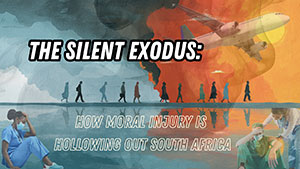
The Silent Exodus: How Moral Injury is Hollowing Out South Africa
A nursing student at a Johannesburg hospital watches a woman give birth on a floor. No healthcare workers attend to her. The student knows this violates everything she learned about patient dignity. She knows she should intervene. But the system is so broken, the understaffing so severe, that she can do nothing. That night, she updates her CV and starts researching nursing positions in the UK.
This is moral injury. Not burnout. Not stress. Moral injury happens when you are forced to violate your deeply held values to survive professionally, when you watch preventable harm unfold and cannot stop it, when speaking up means losing your job or worse.
In South Africa, moral injury has become so normalized it is treated as the cost of staying in the country. It cuts across all sectors: public and private, healthcare and education, municipal offices and state-owned enterprises. It is a systemic failure of institutions, not the product of any single government or political moment. Research shows 34% of nursing students at a Johannesburg university experienced moral injury, forced to witness neglect that transgressed their moral code. One patient was left unfed for over 100 hours, housed with corpses before dying. These students, who entered the profession to heal, now carry wounds that alter their self-concept for life.
The numbers tell the exodus story. More than 914,000 South Africans now live abroad. Between 1989 and 2003, 520,000 people left, with emigration increasing 9% annually. Of those, 120,000 held professional qualifications, representing 7% of our total professional workforce. One in five healthcare workers left after the pandemic. This is not just brain drain. This is a moral haemorrhage.
When Good People Are Forced to Do Bad Things
Life Esidimeni stands as a stark example of institutionalized moral injury. In 2016, the Gauteng Department of Health terminated a contract with Life Esidimeni psychiatric facilities and moved 1,700 mental health patients to unlicensed, under-resourced NGOs. The reason? Cost savings.
Healthcare workers raised alarms. Families went to court. The warnings were ignored. Health authorities, as one research paper notes, “exerted tremendous power and created a culture of fear and disempowerment among healthcare practitioners.”
The result? 144 people died from starvation, dehydration, and neglect. The tragedy was later ruled to constitute torture. Healthcare workers who discharged these patients, who knew they were sending vulnerable people to their deaths, now carry that weight. Many faced a choice: comply or lose your job. Some complied. Some left the profession entirely.
Senior health officials, including doctors who swore oaths to do no harm, made decisions that led to this tragedy. Despite the scale of the horror, criminal proceedings dragged on for years. Only in 2024 did a judge rule that prosecutions could proceed.
What message does this send to every healthcare worker in South Africa? That professional ethics can be overridden when those in power decide otherwise.
The Corporate Betrayal
State capture at Eskom created moral injury on an industrial scale. Employees watched as politically connected networks looted the power utility while the country plunged into darkness. More than 5,400 Eskom employees failed to declare conflicts of interest. At least 334 had direct business interests in Eskom suppliers. R180 million in illicit payments flowed from fraudulent vendors directly to employees.
But focus on the honest employees for a moment. The engineers who knew that substandard coal would destroy turbines but were overruled. The procurement officers who raised red flags about inflated contracts and were sidelined. The managers who tried to implement proper processes and found their careers threatened. In 2018, key employees involved in state capture either resigned or were dismissed. Many saw what was coming and left before the reckoning.
Former Eskom CEO André de Ruyter stated publicly that corruption was costing the utility R1 billion per month and that four criminal syndicates had embedded themselves in the organization. The web of complicity reached into the highest levels of power.
The Special Investigating Unit found that “if there is one golden thread that links everything that goes wrong in Eskom, it is conflict of interest.” But for the employees who refused to participate, the choice was stark: stay silent, or become unemployable in your field.
When Whistleblowers Live in Hiding
The VBS Mutual Bank scandal revealed what happens when you speak up. Municipal officials across Limpopo were bribed to illegally invest public funds into VBS. Over R2 billion was looted from a bank that served poor, predominantly black pensioners and burial societies.
Some municipal employees tried to stop it. One CFO at Capricorn District Municipality threatened to refer irregular investments to the Reserve Bank. She was “put under considerable pressure” by the mayor, who told her that investment decisions were his alone. She persisted and got the money back. Her reward? Intimidation that made her consider quitting.
At Vhembe district municipality, whistleblowers were forced into hiding. One employee, speaking anonymously years later, said: “It is difficult for one to even relax as you never know who is following you. The past five years have been unbearable.”
Patrick Aphane, a union member who blew the whistle on VBS, was attacked outside his home in 2018. He still sleeps “with one eye open” and says government has “dismally failed to protect whistleblowers.”
The message is clear: speak up, and you may die.
The Education Sector’s Rot
At universities and in student funding, moral injury compounds. The National Student Financial Aid Scheme, meant to provide hope to poor students, has become a site of alleged kickbacks and corruption. OUTA released recordings showing service providers allegedly paid millions in bribes to officials. The SIU found R5 billion was possibly allocated to students who did not qualify for funding.
University staff watch NSFAS fail to pay student allowances month after month. They see students go hungry, drop out, or turn to desperate measures. They know the money is there. They know it is being stolen or mismanaged. But they also know that speaking out means career suicide in a sector where jobs are scarce and blacklisting is real.
When the NSFAS board chair resigned in early 2025, her letter cited bullying, intimidation, racism, and threats to personal safety. She was appointed specifically to clean up the mess. She lasted months.
The Cost of Staying
Nearly 11% of South Africans with higher education are seriously considering emigration. They cite crime, unemployment, and infrastructure collapse. But beneath these reasons lies something deeper: the sense that succeeding in South Africa increasingly requires compromising your integrity.
You can be a nurse who provides care despite having no supplies. You can be an engineer who signs off on shoddy work to keep your job. You can be a teacher who watches NSFAS money disappear while your students starve. You can be a municipal official who looks the other way when tenders go to politically connected cronies.
Or you can leave.
This is not just about losing skills. It is about losing the people who still believe things should work properly, who know what ethical practice looks like, who refuse to normalize dysfunction.
South Africa is not losing people because they are greedy or unpatriotic. It is losing people because the moral weight of staying has become unbearable. These are systemic problems that have grown roots over decades, affecting institutions across every sector and level of government. The corruption that drives moral injury did not appear overnight, and it will not disappear with simple solutions.
What Must Happen
Change requires more than good intentions. It requires sustained action from everyone:
Actual consequences for perpetrators. Until those who enable corruption face real consequences, the lesson remains clear: corruption pays. While commissions of inquiry have produced evidence, prosecutions must follow through. Every case that goes unpunished tells professionals that ethics are optional.
Whistleblower protection that works. People who expose wrongdoing should be protected, compensated, and celebrated. Current systems fail those who speak up. We need legal frameworks with teeth and resources to keep whistleblowers safe.
Professional bodies that defend ethical practice. Medical councils, engineering bodies, and educational institutions must actively protect members who refuse to participate in corruption. These organizations have power they are not using.
Economic pathways that reward integrity. Young professionals need to see that you can succeed without compromise. Businesses, institutions, and communities must create opportunities where ethical practice is valued, not punished.
Collective action and solidarity. No individual can fight this alone. Professional associations, unions, and civil society must create protected spaces where people can resist together. Change happens when enough people refuse to accept the unacceptable.
Citizens holding institutions accountable. This is not only a government problem. It is a societal one. Private sector enablers, complicit professionals, and silent witnesses all play a role. Everyone who looks away contributes to the problem.
The Choice
Every skilled South African faces a calculation. Can I practice my profession ethically here? Can I provide for my family without compromising my values? Can I look at myself in the mirror?
For too many, the answer is no.
Some will stay. They will join the fight to reclaim institutions, to rebuild integrity, to insist that the law means something. These are acts of extraordinary courage that deserve recognition and support.
Others will leave, carrying the weight of that decision, knowing they could not survive what staying demanded of them.
Neither choice is wrong. Both carry a cost.
But this much is clear: until South Africa addresses the moral injury it inflicts on its professionals, the exodus will continue. Skills can be replaced. Training can be repeated. But you cannot rebuild a country when too many good people are forced to choose between their ethics and their survival.
This is not about blame. It is about understanding what we are losing and why. It is about recognizing that every person who leaves takes with them not just skills, but hope that things can be different. Every person who stays despite the cost is fighting for that possibility.
The question is not whether South Africa can afford to keep losing people. The question is whether enough of us will choose to be part of the solution rather than part of the silence.