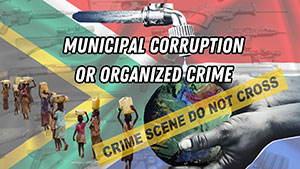
Municipal Corruption or Organized Crime
Two vehicles blocked the road. The message was simple: stop giving away free water, or else.
The Gift of the Givers aid workers had just arrived in OR Tambo District Municipality to help flood victims still drinking from rivers after the June 2025 floods killed 90 people. Now they faced a group calling itself the “water mafia,” with alleged links to municipal water contracts worth millions. This was not random criminal opportunism. It was protection of organized income streams.
Research released by the Institute for Security Studies in November 2025 reveals what many South Africans already suspected. Corruption in many local municipalities operates like organized crime. The study mapped corruption patterns across three municipalities: Madibeng Local Municipality, OR Tambo District Municipality, and the City of Johannesburg. What emerged was not isolated incidents of individual greed, but coordinated criminal networks built on relationships between municipal officials, private contractors, and political appointees.
The mechanics are straightforward. First, influence is gained through irregular appointments based on family, friendship, or political connections that extend into the private sector.
Second, this influence manipulates legitimate systems for personal gain.
Third, protection comes through either administrative cover or violent intimidation.
The patterns are identical across all three municipalities studied. The systematic coordination required to perpetrate, sustain, and conceal these activities mirrors organized crime operations.
Madibeng: The Family Business
Madibeng Local Municipality in North West demonstrates how family and political networks transform municipal government into criminal enterprise. Multiple investigations now underway reveal a system where appointments bypass proper procedures to place connected individuals in strategic positions.
The municipal manager, Quiet Kgatla, was appointed despite not possessing the prescribed qualifications. An internal risk audit found he lacked the required bachelor’s degree in public administration, political science, social sciences, or law. He held different qualifications: a BCom degree, BCom honours, and CA (SA). The recruitment process was handled directly by the mayor’s office, not through corporate support services as required by law. When council attempted to address the irregular appointment, meetings collapsed. Some councillors stayed away to prevent quorum.
This pattern repeats throughout Madibeng. Three senior officials were suspended for allegedly bypassing supply chain management processes and hiring service providers irregularly. The municipality faces allegations of duplicate payments to service providers, bank account tampering, tender fraud, illegal investments, and unauthorised changes to bulk accounts.
One suspended municipal manager, known as “Mr Cash,” faced charges involving bribes exceeding R1 million from at least two companies. Irregular tender awards exceeded R40 million in cases still under investigation.
The coordination required reveals organized crime structure. Networks facilitate financial crimes that require multiple actors: officials who approve payments, supply chain managers who manipulate processes, contractors who inflate invoices, and appointees who protect perpetrators from whistleblowing.
The systematic nature spans years. Madibeng now owes nearly R2 billion to creditors, including R1.48 billion to Eskom and over R800 million for bulk water. Meanwhile, the municipality is owed almost R4 billion by households, businesses, and government departments, much of it uncollectable.
OR Tambo: Monetizing Crisis
OR Tambo District Municipality in the Eastern Cape illustrates how organized corruption exploits service delivery emergencies for profit. The ongoing water crisis created opportunities for systematic looting through relationships between municipal officials, utility employees, and private contractors.
The water and sanitation department operated a prepaid scheme for dam construction projects. Contractors received advance payments. Many projects were never delivered. The former chief financial officer, Moabi Moleko, documented how his investigation found contractors paid for work never done. He submitted an affidavit to the Hawks and visited incomplete projects with investigators before leaving the municipality in 2022.
The scale is staggering. The Special Investigating Unit is investigating five major water projects involving multiple contractors.
The Signal Hill Reservoir project saw irregular payments to Amatola Water Board.
The Manduli Bulk Water Scheme involved irregular payments to Ginasonke Engineers.
The Mganduli Bulk Water Scheme saw irregular payments to Khwalo’s Construction.
A pump installation at Mhlontlo Cluster 1 generated irregular payments to Valotone 94 CC and Phoenix Tanks.
The electrification of Mthatha Dam and construction of Thornbill Clear Water Pump Station involved irregular payments to Amatola across 2018 and 2019.
In July 2023, the Hawks arrested two municipal employees, including the director of water and sanitation, over fraud allegations exceeding R160 million. The arrests followed investigations into millions paid for unfinished and unbuilt dams. Communities around Ntsonyini and Ngqongweni near Port St Johns still draw drinking water from rivers and streams. The dams they were promised remain incomplete or were never started.
One tender, originally budgeted at R20 million, ballooned to R70 million through irregular variations. The SIU discovered one municipal official received R120,000 from a service provider. Evidence showed the same provider bought a vehicle for municipal official use.
The municipality paid R2 million for a boxing tournament processed under a service level agreement that did not cover such events. The SIU concluded officials used the tender to enrich themselves, their friends, and family members.
The water mafia intimidation of Gift of the Givers demonstrates violent protection mechanisms. When legitimate aid organizations threaten illicit revenue streams, intimidation follows. This is textbook organized crime behaviour.
Johannesburg: State Capture at City Hall
The City of Johannesburg demonstrates corruption organization at levels typically associated with state capture. As South Africa’s richest metro, Johannesburg’s procurement systems became targets for systematic exploitation through collusion between officials and private interests.
The Special Investigating Unit documented systemic weaknesses across multiple city agencies and entities. Investigations uncovered collusion between supply chain management officials, bid committee members, and service providers. Tenders for vehicle maintenance, metro police uniforms, and fire station repairs showed suspicious award patterns. Products supplied often did not meet specifications. Overpricing was routine. Systems and processes contained deliberate flaws.
The Auditor-General reported poor consequence management, material non-compliance with procurement and contract management, and high levels of irregular, fruitless, and wasteful expenditure.
Despite these findings, accountability remains absent. The SIU recommended lifestyle audits and background checks for all procurement officials. The recommendation highlights how officials living beyond their means face no scrutiny.
One case exemplifies the pattern.
At the Johannesburg Property Company, five senior employees faced allegations of financial misconduct involving R18.3 million in unauthorised, irregular, fruitless, and wasteful expenditure related to Covid-19 deep-cleaning contracts. The CEO, CFO, and three supply chain officials allegedly awarded contracts at inflated prices without following proper procedures. Despite SIU findings, attempts were made to lift suspensions, demonstrating how political protection shields perpetrators.
The sophistication mirrors state capture methodology.
Weak regulatory and compliance monitoring creates opportunities.
Inadequate skills and capacity provide cover.
Poor oversight from executive authority prevents detection.
Conflicts of interest go unmanaged.
Leadership instability disrupts continuity.
No segregation of duties enables collusion.
Poor record management hides evidence.
The absence of consequence management ensures impunity.
The Real Cost
The numbers are staggering. In the 2022-23 financial year, the Auditor-General identified 268 material irregularities at municipalities with an estimated value of R5.19 billion.
Only 34 of South Africa’s 257 municipalities received clean audits. That is 13%.
Since 2020-21, 36 municipalities have regressed while only 45 showed improvement.
For business, this creates direct operational impact. Municipalities owe Eskom R16 billion. When local government cannot collect revenue, it cannot pay suppliers. Small and medium enterprises face serious liquidity problems. Some collapse entirely. The construction sector has lost 110 engineers and technical personnel who left South Africa due to project disruptions. Construction projects worth a minimum of R25.5 billion have been violently disrupted.
More than 82% of South Africans now believe corruption has increased. Public trust erodes. Communities disengage from democratic processes or take to the streets.
South Africa’s Corruption Perceptions Index score dropped to 41 out of 100 in 2024, falling below the global average of 43 for the first time. Yet 72% of South Africans believe ordinary people risk retaliation for reporting corruption.
Why This Is Organized Crime
The Institute for Security Studies comparison to organized crime rests on clear evidence.
First, recruitment and placement operate like criminal networks. Irregular appointments, nepotism, and patronage build coordinated structures. These are not opportunistic hires. They are strategic placements to control key positions.
Second, revenue streams operate systematically. Procurement fraud, prepaid schemes for undelivered work, bank account manipulation, and tender inflation require coordination across multiple actors. Like drug cartels controlling distribution networks, these operations maintain supply chains of corruption.
Third, protection mechanisms mirror organized crime. Administrative protection comes through placing loyalists in oversight positions that can block investigations and shield perpetrators. Violent protection appears when administrative measures fail. The construction mafia demanding 30% cuts, the water mafia threatening aid workers, these are protection rackets.
Steps Forward
The material irregularity process implemented since April 2019 has prevented or recovered R2.55 billion in financial losses. This demonstrates that enforcement works when properly applied. In 86% of cases, accounting officers took action only after the Auditor-General raised matters. This reveals absence of internal accountability.
National and provincial government must strengthen existing mechanisms.
The Auditor-General needs enhanced enforcement powers and adequate resources.
Provincial intervention in captured municipalities must become faster and more decisive. Transparent, merit-based appointment processes need implementation across all councils. Whistleblower protection requires tangible consequences for those who retaliate.
Corporate South Africa cannot treat this as someone else’s problem. What could they do?
Conduct jurisdiction risk assessments before major investments.
Engage provincial government on municipal governance gaps that affect operations.
Support civil society monitoring initiatives.
Review payment terms in credit policies for municipal contracts.
Collaborate with industry peers on responses to construction mafia tactics.
The tools exist. The evidence is documented. The legal framework is in place. What remains missing is coordinated will to deploy them at scale. Every day this continues, R14 million in financial losses accumulates. Services deteriorate. Investment decisions shift elsewhere.
The choice is simple: treat municipal corruption as the organized crime it has become, or accept the mounting cost of pretending otherwise.