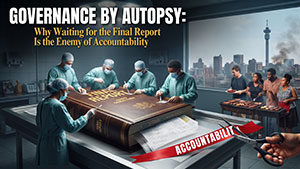
Governance by Autopsy: Why Waiting for the Final Report Is the Enemy of Accountability
Commissions of inquiry are rapidly becoming as much a part of South African culture as rugby and shisa nyama. In beer halls, at backyard braais, and around office water coolers, we can rattle off their names with as much familiarity as we do our own children’s.
Zondo. Mpati. Khampepe. Madlanga…we no longer associate these surnames with the respected individuals they belong to. Instead, they’ve come to represent mind-numbing tedium; endless public testimonies that stretch on for months, cost billions of Rands, yet yield painfully little in the way of tangible results.
Despite this dismal return on investment, South Africa persists with them. President Ramaphosa in particular remains a steadfast advocate – to the point where these inquiries have effectively come to define his presidency since he first took office in 2018.
But not everyone shares his enthusiasm. While some view these commissions as vital, truth-seeking exercises necessary to heal a nation, critics argue they merely muddy the political waters, actively stalling real-time, decisive law enforcement.
Political analyst Bheki Mngomezulu is one such critic, describing the commissions as “unnecessary,” largely because they lack any statutory prosecutorial power.
“They compile reports and do nothing,” he argues. “Look at the State Capture Commission, which cost over a billion rand. Why appoint a commission and spend public money when the National Prosecuting Authority still has to conduct its own separate investigations anyway? Why not go directly to the NPA from the start?”
It is a valid question – and one that no one in a position of power has yet seen fit to answer.
His concerns are echoed by Polokwane legal practitioner MK Masoma, who believes the inquiries have become the government’s default political shield when facing public outrage. He acknowledges that while they often produce painstakingly detailed findings, this findings of this exhaustive work are largely negated by the systemic failure to hold anyone accountable afterward.
“Exposure without action risks entrenching impunity rather than confronting it,” he warns.
Another legal expert, Mpumelelo Zikalala, believes the accountability of these commissions would be significantly strengthened if their reports were made public. He says South Africans have the right to know if:
The commission has been effective.
The government is implementing its findings.
We, as a country, have got value for money?
“If you are going to be secretive with what you’ve received, you remove the very accountability that you must have on a daily basis as the presidency,” he says. “You limit us as members of the public in terms of holding you accountable in terms of what has been provided by the commission. It’s almost as if it’s business as usual. The silence is too loud.”
An encouraging exception to this frustrating blueprint may be emerging in the Madlanga Commission, which is quietly achieving swift suspensions and active prosecutions of corrupt officials even while hearings are still underway.
Formally titled the Judicial Commission of Inquiry into Criminality, Political Interference and Corruption in the Criminal Justice System, the Madlanga Commission was established in June last year by President Ramaphosa, following explosive public allegations by KwaZulu-Natal police commissioner Lt-Gen Nhlanhla Mkhwanazi.
Its main job is to investigate claims that elements within the justice system have been “captured” by organised crime and political influence, and, if they have, to recommend tangible steps to fix it. Crucially, by sharing real-time evidence directly with prosecutorial bodies, Madlanga is proving that an investigation doesn’t have to conclude before accountability begins.
The inquiry is critically important because it addresses the very questions South Africans have been asking for years: how deep does the rot go, and can a commission finally deliver justice instead of just another expensive report?
It certainly looks as though it might finally break the mould, providing vital lessons for corporate governance, board oversight, and risk management, and delivering a definitive framework for how both state and corporate bodies investigate corruption.
And there’s no doubt corporate South Africa needs those lessons.
Right now, most businesses unwittingly copy the Zondo model when it comes to tackling fraud and corruption. They commission a forensic investigation, then wait months for lengthy, expensive reports to be finalised before taking administrative or legal action. By then, assets have been stripped, evidence wiped, and perpetrators have resigned with clean records.
It’s governance by autopsy, and it’s a disaster.
For South African organisations, the overarching lesson from the Madlanga Commission is clear: passive governance is complicit governance.
Integrity cannot rely solely on policy documents; it requires real-time enforcement, absolute independence for oversight functions, and the moral courage to act immediately when red flags appear.
If you are in a position of leadership within your business, here are concrete steps you can take right now to improve your company’s response to allegations of corruption:
Upgrade due diligence. Shift third-party screening and vendor onboarding from tick-box compliance to proactive threat intelligence.
Protect independence. Strengthen the autonomy of assurance functions, creating clear boundaries between executive management and board oversight to prevent tampering.
Adopt agile compliance. Ensure investigation mandates include interim reporting triggers, allowing boards to execute precautionary suspensions, freeze suspicious payments, and report criminal acts to law enforcement in real time.
Build independent reporting channels. Establish whistleblowing channels that bypass executive management entirely, routing directly to an independent social and ethics committee or legal counsel.
Safeguard oversight functions. Protect specialised risk and compliance teams from political or budgetary pressures within the firm, maintaining institutional memory through C-suite changes.
Act early. Deploy precautionary suspensions as an immediate operational tool to protect evidence and assets, rather than treating them as a post-investigation consideration.
The bottom line is this:
When companies treat internal forensic investigations as academic exercises in historical documentation, they’re doing nothing more than building a shield for the guilty.
The lesson from public sector inquiries is unmistakable: when you delay action, the consequences of corrupt behaviour are minimal. Real-time accountability models are the only mechanisms that yield swift suspensions, secure prosecutions, and re-establish genuine institutional integrity.