Do desperate times justify desperate measures?
At the end of this month, we face a perfect storm.
Initially, the recent war in the Middle East seemed reassuringly far away. As a country that’s historically seen more than its fair share of conflict, South Africa felt safe from the trouble, shielded by distance and ideological neutrality.
A scant few weeks later, however, and the situation is very different. The ripple effects of the US and Israel’s bombardment of Iran and Lebanon are now knocking at our door.
The main issue for us is a catastrophic rise in the price of fuel.
April data from the Central Energy Fund (CEF) shows massive under-recoveries – up to R3.63 a litre for petrol and an astonishing R10.80+ per litre for diesel.
According to a report in Autotrader, the result will be an estimated at-the-pumps increase in May of R3.50 to R4.00 per litre for petrol and R4.00 to R4.50 per litre for diesel. If the government fails to extend the current R3.00 levy relief, this will be the single biggest fuel increase in our history.
Of course, a price hike this huge is never only going affect us on the forecourt.
“This looming spike threatens to ignite an inflationary wave, driving up the cost of public transport, logistics, and grocery staples just as the economy enters a critical quarter,” says the report.
For many South Africans, transport already eats well over a third of monthly income. Every additional Rand spent on fuel is one less spent somewhere else in our already struggling economy.
Agriculture, too, will feel the impact of this increase very deeply. Farming equipment and irrigation pumps are powered by diesel, and produce is moved by gas-guzzling trucks. Higher fuel prices invariably show on supermarket shelves within one to two months, pushing the price of even basic staples such as bread, milk and maize ever upwards.
And I haven’t yet even dared to mention our electricity supply, which we all know relies far too heavily on diesel-munching generators.
The latest Cost of Living report by the Competition Commission reveals electricity inflation in South Africa has almost doubled (by about 85%) in the last five years.
And that doesn’t even take Eskom’s latest price hikes into account – in July, direct consumers will pay 8.8% more, while Municipalities will have to find an extra 9%.
The cost of water (that’s if and when there is actually any in our taps) has also increased – almost 70% since 2021.
All of which means it’s unlikely we’ll avoid a fresh wave of inflation.
Annabel Bishop, Investec’s chief economist, predicts that oil prices of around $110 per barrel, coupled with a weakening rand, could see consumer inflation crest the 4% year-on-year mark in the second quarter of this year.
Experts believe this might force the South Africa Reserve Bank to hike interest rates to stop the Rand from tanking any further.
So although the current crisis in the Middle East is nothing to do with us politically or geographically, it is everything to do with us financially.
Not surprising, then, that millions of South Africans are really struggling. Many are taking risks they would not normally even think of taking if times were different and budgets were not as constrained.
Regular readers of my articles will know I write frequently about the high levels of fraud and corruption that characterise swathes of South Africa’s corporate and public service sectors.
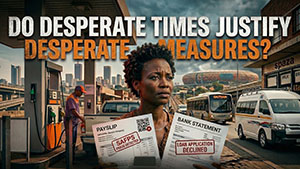
But increasing financial pressures now mean more and more “regular people” are being tempted to commit fraud. One of the more worrying ways this is playing out is the new “trend” of people buying fake payslips and bank statements online to help them secure a home loan.
The fake documents, which can cost as little as R400, are unfortunately not the silver bullet people believe them to be.
In an interview with the Daily Investor, Hannah van Deventer, the national director of Phoenix Bonds, warns that banks now have systems that can detect forgeries in seconds. These include QR‑code verification, unique document identifiers, metadata analysis, and automated fraud‑detection systems.
If you’re caught out, not only will you not get a home loan, you could find yourself facing criminal charges, and a 10-year negative listing with the South African Fraud Prevention Service (SAFPS). This has several severe consequences:
Your fraud charge will be visible to banks, insurers, lenders, and many employers for 10 years.
It cannot be “fixed” by paying off debt
You will likely be blocked from accessing home loans, vehicle finance, and business funding
You won’t be able to access credit for the entire time that you are blacklisted.
If you can’t access credit, paying cash becomes your only option for purchasing anything. And if people don’t have the cash, they’re often forced to use the services of predatory, unregulated lenders.
It’s a scary, downward spiral that’s extremely difficult to get out of.
“A SAFPS listing is effectively a financial death sentence. You can recover from bad credit. You cannot easily recover from fraud,” she says.
Hannah is also eager to remind those who may be tempted down this route that they are not actually purchasing access to credit, but rather heading directly into criminal territory and possible imprisonment.
“People turn to fake documents because they feel embarrassed, out of their depth financially, or they believe the misinformation out there,” she says. “And yet there’s almost always a lawful, structured path to qualifying for a home loan.”
At the end of the day, your credit standing and integrity are the only tools you have to navigate an economy this volatile. You have to do everything possible to protect them.
If you are struggling, pivot to legitimate strategies:
Engage with creditors immediately to negotiate restructured payment plans
Consult with a registered debt counsellor
Speak openly and honestly with your bank
The solution is not a R400 fake payslip or bank statement. Because it may not end up costing R400 – it could, instead, cost you everything.